What one truth about being an artist would you share with a younger artist?
Plan carefully; Take risks and don’t stay in your comfort zone; Don’t expect the Muse to visit all the time, but keep working on something every day.
What one truth about being an artist would you share with a younger artist?
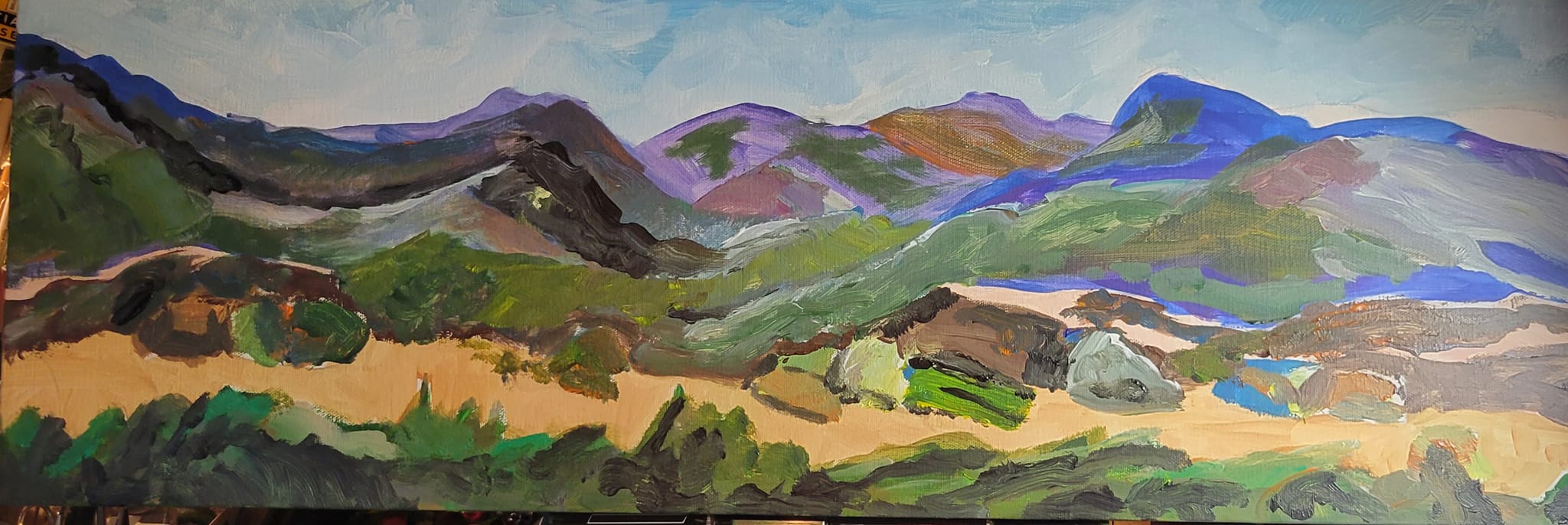
This is an effort to make a scene I'm quite familiar with more abstract

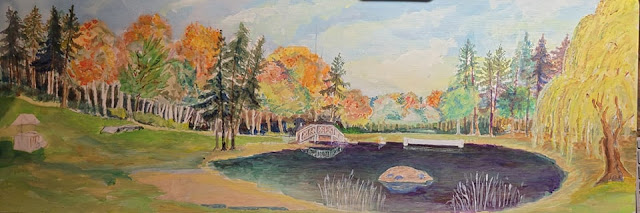
A client asked for a house portrait. Customarily, when doing a house portrait I interview the residents of the house to determine their interests and what unique things they would like in the completed image. In this instance they told me the location from which the house was to be painted.
Yet during an interview and a site visit it was evident that a key feature of the property, a koi pond, lovingly built over time by one of the couple, would not be clearly visible from the preferred vantage point. Additionally, on the site visit I could see that much of the family's outdoor entertaining and visiting was conducted from a deck overlook above the pond. It seemed certain that providing a portrait without the pond was as if one did a portrait of a couple with only one person in the picture.
So I elected to include, as part of the original agreed upon commission price, the pond.


Commissions are often a challenge. Sometimes the query isn't clear. But I learn from each of them.


Venture Smith was a prominent member of the East Haddam and Haddam communities in the early 19th Century. Venture Smith was an African-American farmer and craftsman. Yet, except for his own accounts, there seems little to document his contributions to Haddam Neck and East Haddam. This painting of First Church, Congregational, is thus symbolic perhaps. His family burial area at the cemetery adjacent to the Church is prominent and overlooks to the sanctuary. In his early sixties, he was unjustly charged with the loss of a white man's property and charged for ten pounds while visiting New London. Although being absent from the scene with witnesses, he was still prosecuted. Smith then carried this matter to other courts, claiming his innocence, but the judgment was never reversed. This misleading judgment was made out of discrimination against Black people. Remembering this experience, he said: "Captain Hart was a white gentleman, and I a poor African, therefore it was all right, and good enough for the black dog.[9] " It would not be surprising, then, that even though he achieved financial success before he died, that - as an African man - the powers-that-be kept a certain social isolation between the white settlers and Smith. Just like the stone wall keeps the Smith family gravesites apart from the European area settlers. |
 |
Smith experienced multiple personal setbacks. He bought an enslaved Black man for 400 dollars. However, he wanted to return to his old enslaver, so Smith released him. Venture Smith purchased another enslaved Black man for 25 pounds. After his daughter, Hannah was married, she came down with an illness. However, her husband did not pay adequate attention to her health. Although Smith nursed her, she died. In 1775, Smith bought a farm at Haddam Neck, on the Salmon River, in Connecticut. By 1778 he had expanded the initial 10 acres to form a farm of at least 130 acres. Additionally, he made a living by fishing, whaling, farming his land, and trading in the Long Island basin. He lived the remainder of his life at Haddam Neck.[1] |
(Birth name: Broteer Furro) (c. 1729 – 1805)
Venture Smith (Wikipedia) https://en.wikipedia.org/wiki/Venture_Smith
Naming the site after a local Native American Indian was considered a small political token to the Cherokee in compensation for the dam-flooding and destruction of their historic sites that TVA required to control flooding on the Tennessee River.
 |
| At the Sequoyah Birthplace Museum, Lavore, TN ~ plein air watercolor (c) 2011 / Will Brady |
In a sense, the Sequoyah Birthplace Museum is also a monument to the "Second Trail of Tears" for the Cherokee Nation.

 |
| oil on canvas board. |


Pennsylvania Farmlands