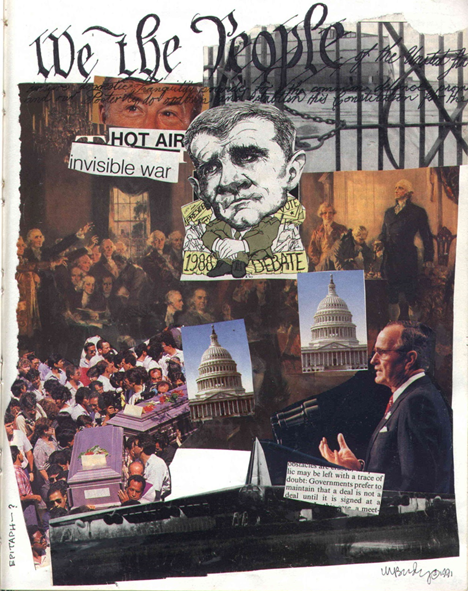
Made during G H W Bush's incursion into Kuwait and Iraq
 |
| Unrepealableness Jussanjuan |
 |
| Rough Sanctuary |
 |
| Bees Harvesting brown arrows |
 |
| Obsidian |
Alex Grey: born Columbus, Ohio / November 29, 1953
“It is the light that is sublime in Grey’s oeuvre - which is the most important innovation in religious light since the Baroque - and that makes the mundane beings in them seem sublime, in every realistic detail of their exquisite being”.
 |
| Praying: 1984 48 x 36 in oil on linen |
An American visionary artist, author, teacher, and Vajrayana practitioner. He works in multiple forms including performance art, process art, installation art, sculpture, visionary art, and painting.
His father was a graphic designer and encouraged his son’s drawing ability. Themes of death and transcendence weave throughout his artworks, from the earliest drawings to later performances, paintings and sculpture.
Training:
Grey's paintings are a blend of sacred, visionary art and postmodern art. He is best known for his paintings of glowing anatomical human bodies, images that “x-ray” the multiple layers of reality. His art is a complex integration of body, mind, and spirit.
Many of his paintings include detailed representations of the skeleton, nervous system, cardiovascular system, and lymphatic system. Grey applies this multidimensional perspective to paint the universal human experience. His figures are shown in positions such as praying, meditating, kissing, copulating, pregnancy, birth, and death.
Grey's work incorporates many religious symbols, including auras, chakras, and icons with geometric shapes and tessellations in natural, industrial, and multicultural situations. Grey's paintings are permeated with an intense and subtle light.
His highly detailed paintings are spiritual and scientific in equal measure, revealing his psychedelic, spiritual and super-natural view of the human species.
You can see the works of Alex Grey on permanent exhibit at the Chapel of Sacred Mirrors [CoSM] -
". . . a sanctuary for seeing ourselves, the world, and our cosmos as reflections of the Divine. CoSM's mission is to build a temple to preserve and share a collection of visionary art beloved by a global community. Forty acres of beautiful woods and newly renovated buildings invite the contemplation of art and nature, and provide a center for events encouraging the creative spirit.
"CoSM honors the mystic core of love uniting all wisdom traditions and the transformative power of art to awaken human potential."
CoSM is located at 456 Deer Hill Road, Wappinger, NY 12590 USA : Phone 845.297.2323

In 2017, a friend working at Farrar, Straus and Giroux posited some questions about journal keeping. The following was one of them, and here was my response.
How has journal-writing changed you? Is it or has it become an important part of your identity? How do you feel your identity has informed and shaped your journal-writing? (You can consider your “identity” however you like, but feel free to consider specific categories such as your gender, sexuality, race, ethnicity, nationality, class, age, faith, ability, mental health, geography, profession, educational background, family structure, etc.)
v Hmm. Tough to say if journaling has “changed” me. I have kept journals for so long I’m not certain what or how it has contributed to my personality.
v
The
Journal IS a part of my
identity in that if I go somewhere without either a journal or camera people
will ask where the journal is, and why do I not have it with me.
v
My
“identity” fits into many categories. I have written on or entered materials
related to, many different subjects including:

v
All of
the above and, I am certain, other subjects, contribute in the shaping of my
content, writing, thoughts and journal entries
Compiled in 2011, I'm told the watch is still keeping time almost ten years later


On the right, Montréal based
portraitist Yvon Goulet shows me pretty much how I look now – minus the cigar.
You can find me posting about art at:
https://willbradyvisualarts.blogspot.com/
over-posting on Facebook at:
https://www.facebook.com/rondacker
and under-posting at:
http://willbradyjournal2.blogspot.com/
Three Small pieces I've done:
 |
| Hot Stuff (c) 2011/Will Brady |
 |
| Juseice (c) 2020 / Will Brady |
 |
| Lug (c) 2009 / Will Brady |
 |
| Self Portrait |
But it is not mere sittings he does; you - the viewer - are simultaneously immersed in the scene wherein the person has been observed. They are not formal studio portraits, but people engaged in everyday life; life on the edge, in fact . . . and their are beings as vibrant and alive as one would find them in real life.
To wit:
 |
“The Called” 2020 36 x 50 oil |
Strasburger tells of himself:
born and raised in a working class neighborhood in Scranton, PA. His first artistic influences were the murals in the Catholic Church he attended as a child, admiring and studying the stories and anatomy.
His work is characterized by a strong observation of humanity, of our physical beauty and our goodness. He works mostly in oils and loves drawing as well. He is influenced strongly by his neighbors and the landscape around him, with a focus on what unites us as aware people.
Strasburger is prolific, with many solo exhibits throughout the Southwest and has won several awards for his work. He currently lives and paints full time in Tucson AZ.
Artist's Statement:
Human nature interests me in how it doesn’t change despite a changing society. My work illustrates our commonality. My work is classical in style, and contemporary in content. A comment I’ve heard by someone in response to seeing my paintings is: “This is me.” Would you like to see more? Contact me with your interest and I’d be happy to share more examples with you.
 |
These are but two examples. His other works are dynamic as well. Don't take my word for his work. See it for yourself:
https://georgestrasburger.com/
All works in this entry are (c) 2020 / George Strasburger and are presented here as informational only. Reproduction of his work elsewhere should be obtained directly from the artist.
Other ways to contact him:


 |


WHAT IS PUBLIC ART? (from 2004)


 New London, Connecticut | 29 January 2005 marks the 26th year for the annual Hygienic "no judge, no jury, no censorship" art exhibition |
 is a relatively new artists' colony [if it's not too soon
 of 460 acres of pristine forest and wetlands | This property is, itself, surrounded by a couple of thousand acres of protected, undeveloped state and privately held lands, all inside Connecticut's Eight Mile River Watershed ~ currently under review for a National Park Service Wild and Scenic Rivers designation |
 the globe | Visiting artists' works from past retreats are either scattered around the grounds or archived within the half dozen or so buildings that make up the campus |
 beginning has been acheived, getting artists of skill and self-discipline to come and immerse themselves in their craft | The next segment is to see about expanding the scope, so that perhaps as many as 12 artists can be on site each retreat period, which can last up to three months | The goal is to remain small, however, and it seems clear the intent of the organization is to preserve the
  bulk of the forested property as undeveloped open space, in keeping with the surrounding area |
 shall watch with interest |
 idea doesn't seem far fetched | And what a beautiful, contemplative place for the dead to be laid to rest, even as ashen remains |
 locale], showing videotaped interviews, musical scores [written while on retreat] and poetry readings of talent unmaksed while here on past retreats |
 From the Fairmount Park Art Association website a thoughtful read |
What is public art?
Public art is not an art “form.” Its size can be huge or small. It can tower fifty feet high or call attention to the paving beneath your feet. Its shape can be abstract or realistic (or both), and it may be cast, carved, built, assembled, or painted. It can be site-specific or stand in contrast to its surroundings. What distinguishes public art is the unique association of how it is made, where it is, and what it means. Public art can express community values, enhance our environment, transform a landscape, heighten our awareness, or question our assumptions. Placed in public sites, this art is there for everyone, a form of collective community expression. Public art is a reflection of how we see the world—the artist’s response to our time and place combined with our own sense of who we are.
Who is the “public” for public art?
In a diverse society, all art cannot appeal to all people, nor should it be expected to do so. Art attracts attention; that is what it is supposed to do. Is it any wonder, then, that public art causes controversy? Varied popular opinion is inevitable, and it is a healthy sign that the public environment is acknowledged rather than ignored. To some degree, every public art project is an interactive process involving artists, architects, design professionals, community residents, civic leaders, politicians, approval agencies, funding agencies, and construction teams. The challenge of this communal process is to enhance rather than limit the artist’s involvement.
What is the “art” of public art?
As our society and its modes of expression evolve, so will our definitions of public art. Materials and methods change to reflect our contemporary culture. The process, guided by professional expertise and public involvement, should seek out the most imaginative and productive affinity between artist and community. Likewise, artists must bring to the work their artistic integrity, creativity, and skill. What is needed is a commitment to invention, boldness, and cooperation—not compromise.
Why public art?
Public art is a part of our public history, part of our evolving culture and our collective memory. It reflects and reveals our society and adds meaning to our cities. As artists respond to our times, they reflect their inner vision to the outside world, and they create a chronicle of our public experience.
 Tonight I go to watch a watercolorist whose work I admire conduct a "hands-on" class exhibiting his technique |
 I ever seem to be myself | In fact, the photo on the left is a still from a cooperative extension class I took a year ago at her insistence | The image to the right is from one of those classes | Thank you Joyce, keep on me about painting | I need a "discharge plan" from my present line of work |
 Fisherman | By the way, this is the piece I donated to the Moodus Sportsman's Club raffle a couple of weeks ago | I did it for my Dad, who passed away in 1996 | He loved fishing and when I was a kid saw to it we got to share his love of the sport, even if we didn't get to go out very often | I hope it is now with someone who loves fishing as much |
 Sometimes words fail me and I have to "speak" through what I see |


